Not every product should be decanted
Start by checking the product manufacturer's instructions and the travel bottle's material information. A container intended for shampoo is not automatically suitable for every liquid. Some products should remain in their original packaging when it matters for protection, dispensing or clear identification. Do not combine unknown mixtures, and do not use travel toiletry bottles as improvised medicine containers.
Estimate the amount needed from your normal use and the trip length. A modest reserve is more useful than filling every available bottle to the brim. Check that the size is comfortable to hold and that the product can actually pass through the opening. A thick cream behaves differently from a thin lotion, so a bottle that suits one may be awkward for the other.
Check closures and cleaning access
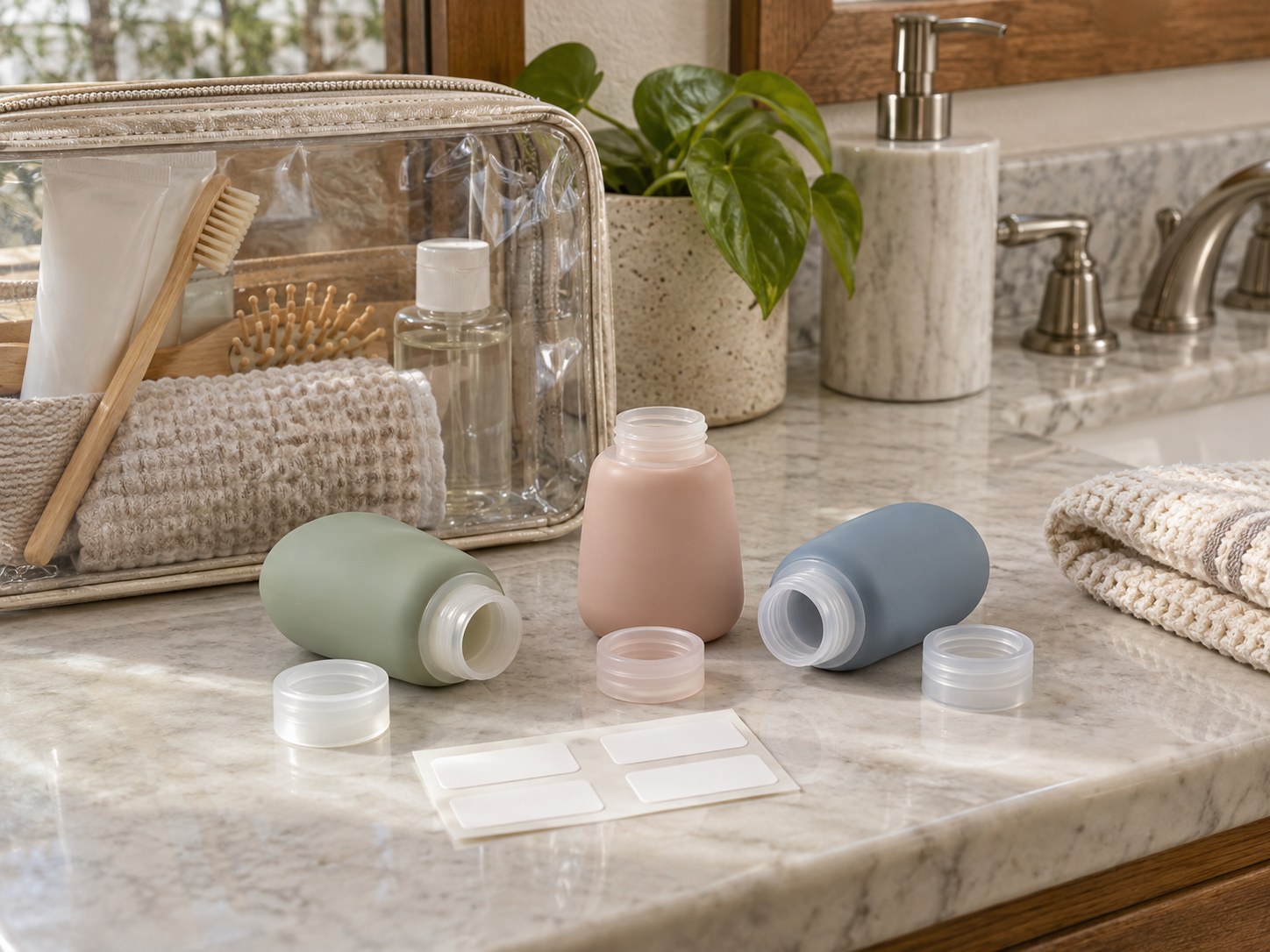
A wide neck makes filling and cleaning easier, but may come with a larger lid. With a narrow opening, make sure residue can still be removed. Only dismantle parts that the manufacturer intends to be taken apart. If a corner remains damp or cannot be reached, the design may be inconvenient for repeated use even if it looks compact when new.
Test the closed container separately from your luggage before travelling. Watch for liquid collecting around threads or a flip cap. This cannot guarantee performance in every transport condition, but can reveal obvious faults. Pack bottles so that a possible leak will not immediately reach clothing or documents. A closure test and sensible separation serve different purposes and are worth considering together.
Keep the contents identifiable
Label each bottle with its actual contents. Colour coding alone can become confusing when several people use similar containers or the selection changes before another journey. Use a label that remains readable with ordinary moisture. Keep important product information separately if it would otherwise be lost when you decant the contents.
Before a flight, refillable containers must still meet the current requirements of the relevant security checkpoints. Container capacity may matter, rather than just the amount of liquid left inside. Check airport information before departure: a set marketed as travel size does not replace that check.
After the stay, empty and clean the bottles according to their material instructions. Allow every part to dry before closing them for storage. Before refilling, inspect for odours, residue and damage to closures. Reusable means the care routine must be repeated too; that is what keeps a small bottle set a manageable part of your luggage rather than a collection of unidentified leftover products.