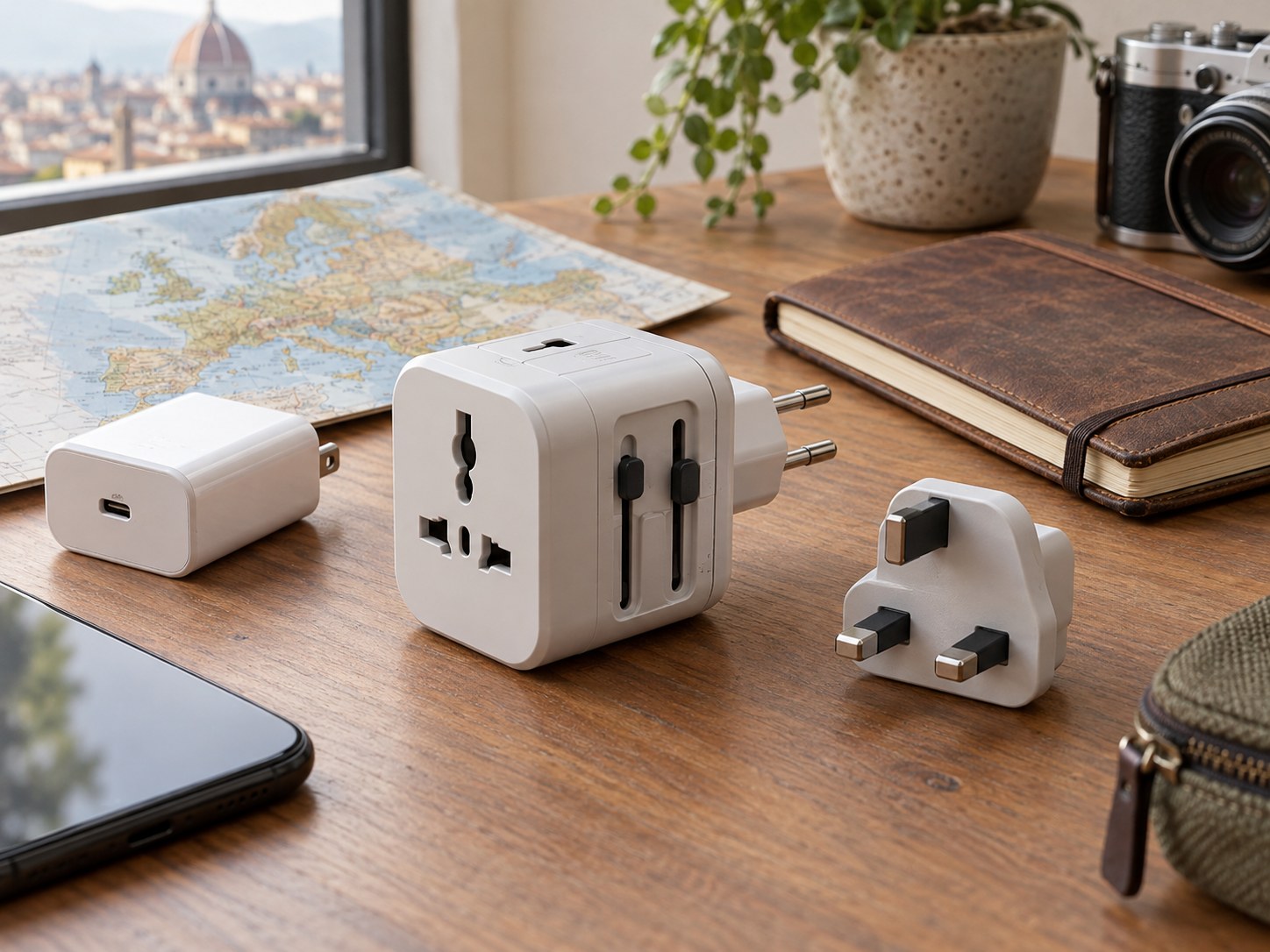
Start with the devices
Lay out the devices and chargers you actually intend to bring. Check the input information printed on each power supply and read its instructions. A physically compatible plug alone does not establish electrical compatibility. If information is missing or unclear, ask the manufacturer rather than testing the combination by trial and error. High-power appliances have different requirements from a small phone charger.
Also record which plugs and charging cables you genuinely need. A device with a USB connection may be chargeable from an existing compatible power supply. However, that does not mean every USB port provides the same output or supports the same charging protocols. Compare the device, charger and cable specifications together before deciding that one connection can replace another.
Check the particular destination
Research socket types and the electrical supply for the actual country. Europe contains different systems, so a product broadly labelled a European adapter will not necessarily suit every stop. For a multi-country trip, check all destinations rather than only the first overnight stay. A universal design is only as versatile as the connections its manufacturer explicitly supports.
Compare the adapter's permitted load with the intended use. Do not stack multiple adapters to work around an unsuitable connection. A loose mechanical fit, visible damage or unusual heating are reasons to stop using the arrangement. Follow the manufacturer's safety information and the accommodation's instructions. Improvised electrical work is not an appropriate way to solve a travel packing problem.
Prefer manageable access over the most sockets
A large adapter with numerous outlets may block neighbouring sockets or sit awkwardly in a poorly positioned wall outlet. Think about how many devices must charge at once and how much time is available. Charging two items consecutively may be simpler than carrying an unnecessarily heavy multi-outlet unit. Still allow enough time to charge your phone before an early departure.
Before leaving home, check that all intended parts are present and that loose modules can be identified inside their transport pouch. Save a photograph of important product information for reference during the trip. This does not replace markings on the device itself, but can make advance planning easier.
Pack the adapter with its matching cables somewhere accessible. After a late arrival, you should not need to empty the entire suitcase to find it. Keep the arrangement simple enough to check quickly before leaving the room. A suitable adapter is a deliberately selected connection component, not a universal substitute for checking the equipment that will be attached to it.